Google Search vs. AI Search: What Actually Changed
I typed something into Google the other day and caught myself feeling a little impatient. Ten blue links. A few ads. A “people also ask” box I had to scroll past.
Then I asked an AI the same question. It answered me in a few seconds, in plain language, like a friend leaning over to tell me what they know.
That difference is small on the surface and pretty big underneath, and it led me to ask the question: what is the percentage of AI searches vs Google? The answer is that 37% of consumers now say they start their search with AI rather than Google, but that google now accounts for almost 70% of searches.
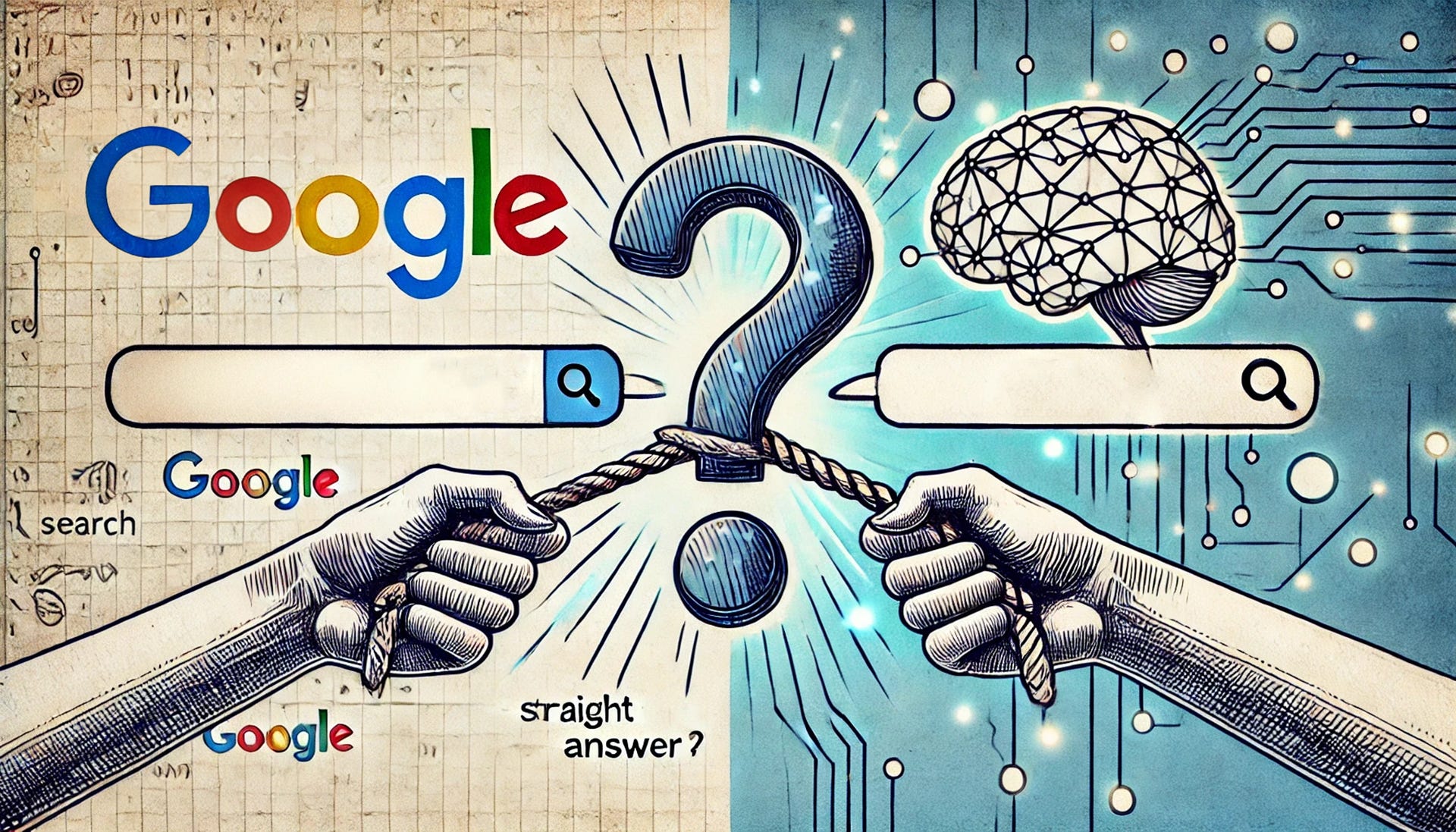
Google gives you a map. AI gives you directions.
When you search on Google, you’re handed a list of places that might have your answer. You still have to click in, read around, compare a few sources, and piece it together yourself. That’s not a flaw, really. It’s just how the tool was built. Google’s job has always been to organize the internet, not to read it for you.
AI search skips that step. It’s already read the internet, or a good chunk of it, and it hands you a synthesized answer. No tabs. No skimming five articles to find the one paragraph that actually matters.
One rewards patience. The other rewards a good question.
With Google, the skill was knowing how to search. Keywords, quotation marks, the right phrasing to get past the noise.
With AI, the skill is knowing how to ask. You can be conversational. You can follow up. You can say “wait, what did you mean by that” and actually get a real response back. It feels less like operating a search engine and more like talking to someone who’s done the reading.
Google shows its work. AI tells you the conclusion.
When Google gives you ten links, you can see where the information is coming from. You’re choosing your sources, even if you’re not always conscious of it.
AI search often blurs that. The answer arrives but the sourcing is sometimes a citation, sometimes a vague gesture, sometimes nothing at all. That’s not a reason to distrust it. It’s just a reason to stay a little curious. Ask where something came from. A good AI tool will tell you.
So which one is better?
Wrong question, honestly. They’re built for different searches.
Google still wins when you want options. Comparing flights, browsing recipes, reading a few takes on the same news story before forming your own opinion. You want the map, not just one route.
AI wins when you want a real answer to a real question, fast. “What’s the difference between baking soda and baking powder.” “How do I write a polite but firm email.” “Explain this contract clause to me like I’m not a lawyer.” You want the directions, not the map.
I’ve stopped thinking of it as one replacing the other. I’m aware of the environmental impact of both tools. But I’m also a realist and know that a lot of people will be using AI for searching purposes. The big question is: are you ready?
AI is looking for:
1. Questions that are already answered, so ensure your website has an FAQ section. AI is building a search that already has the answers to the reader’s questions.
2. Build industry-specific landing pages with depth. AI loves to cite websites confidently.
3. Restructure your testimonials as case studies. AI loves transformational stories so make sure your website has a review/testimonial section that is easily searchable.
4. Add author credentials to every article. Ensure your name along with your credentials are on every article and page that you’re writing. AI rewards demonstrated expertise from named and credentialed individuals.
5. Structure your website so that AI systems find a specific answer, trust the source and cite it.
6. The only AI tool for searching YouTube is Gemini. None of the other AI tools will search or cite it.
If you need more information or just need some clarity, reach out to me. I’m happy to help.